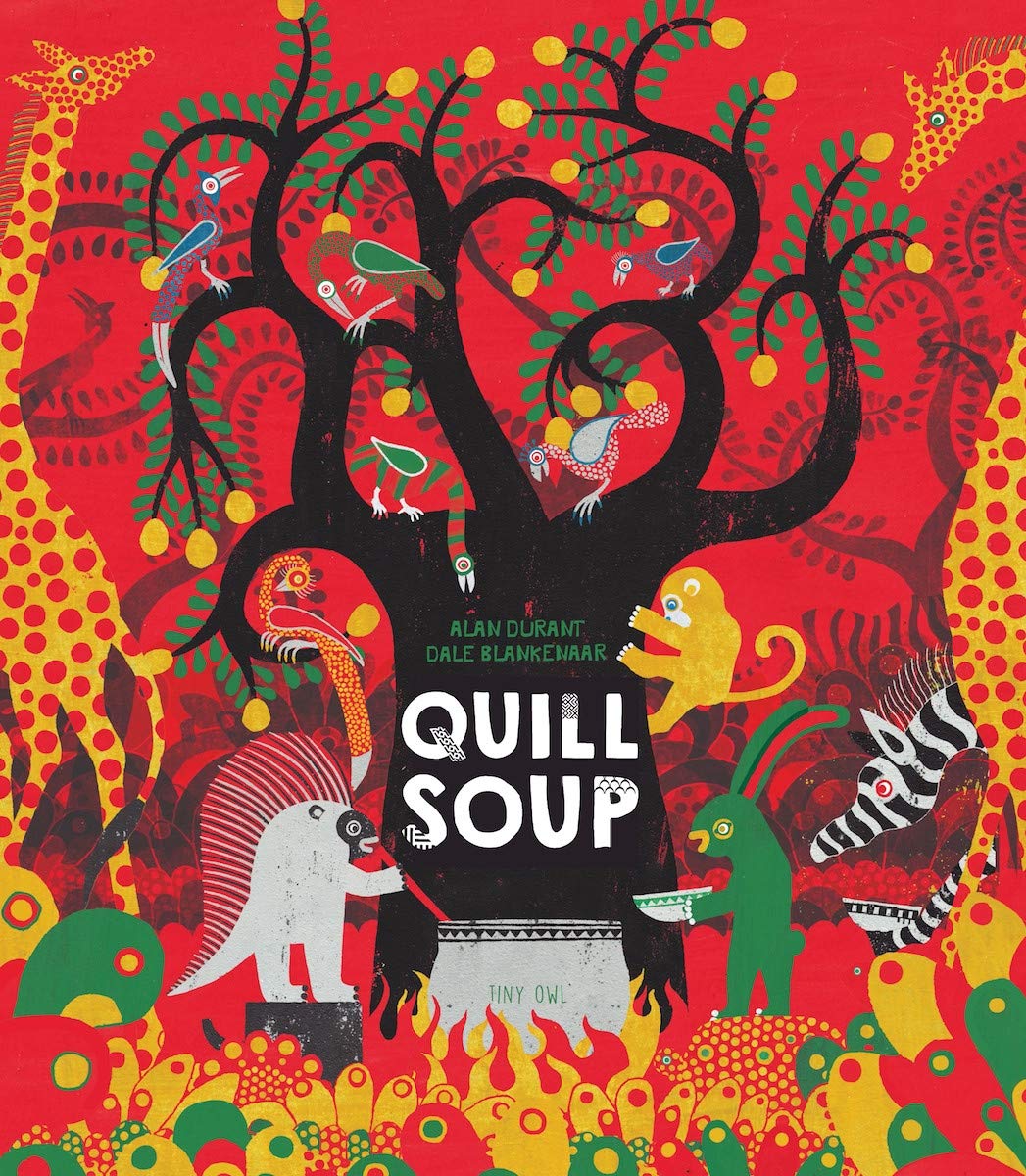
Quill Soup by Alan Durant and Dale Blankenaar, Tiny Owl Publishing
Review by Sue McGonigle an independent consultant and co-creator of www.lovemybooks.co.uk. She is also a member of the English 4-11 editorial board
Noko the porcupine arrives at a village tired and hungry after a long journey. But the villagers are far from welcoming, wary and selfish they deny having food to share. Knowing they are lying Noko decides to play a cunning trick on them. He starts making soup with a few of his quills, a meal he alleges he prepares for the king. Intrigued and impressed, in no time at all the previously unfriendly villagers find that after all they have additional ingredients to add to the pot and improve the soup. This is an amusing and clever retelling of the European trickster tale Stone Soup set in South Africa, the village inhabitants include meerkats and pangolins. The illustrations are striking, full of detail and activity contributing to the storytelling by, for example, refuting the villagers claims to have no food! Quill Soup is a story with a powerful message about generosity and kindness with a setting and cast of characters which might invite enquiry into African wildlife and endangered species.
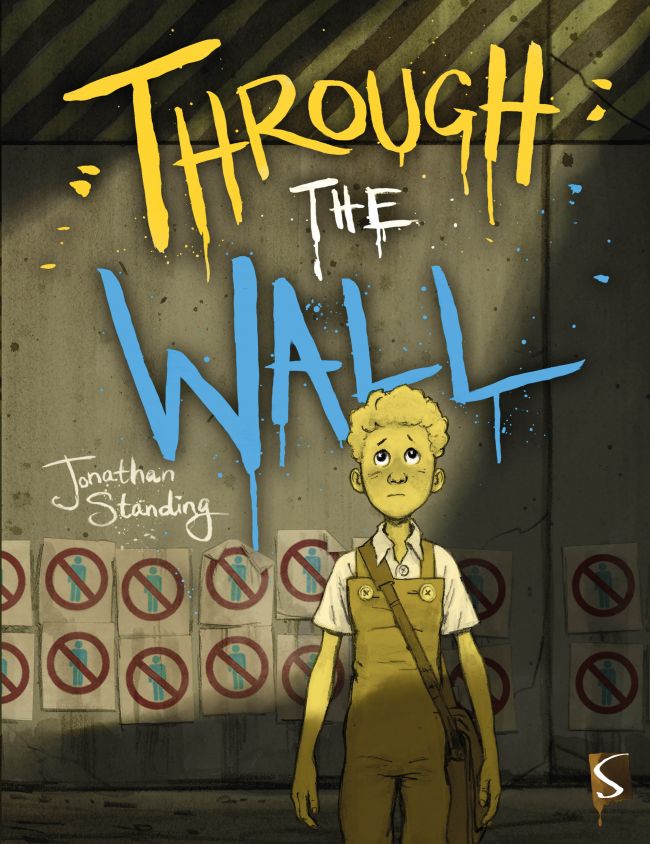
Through the Wall by Jonathan Standing, Salariya Book Company
Review by Sally Wilkinson, a Primary SCITT Leader for Suffolk and Norfolk SCITT leading the team and working with partnership schools to train primary teachers. Current Chair of the English 4-11 editorial board.
There are two groups of people in this story: the yellows and the blues. In the beginning they are separated either side
of a wall. Opposite the title page is a proclamation ordering all the yellow citizens to stay on their side of the wall. As you read the story, parts of the proclamation appear at the foot of each double spread and contrast with the message provided by the illustrations and text covering most of the page. This juxtaposing helps the reader do exactly what the main character, a lonely boy, also does – question the truth behind the proclamation. This leads to him finding a friend, a blue girl, but she is on the other side of the wall. They hatch some creative plans to be together and at last one works. Not only are the two friends united, so are all the yellow and blue people as the wall crashes to the ground. This story could support many discussions about relationships. For older children it could provide an accessible way to consider current and past situations where propaganda and physical divides have driven neighbours apart
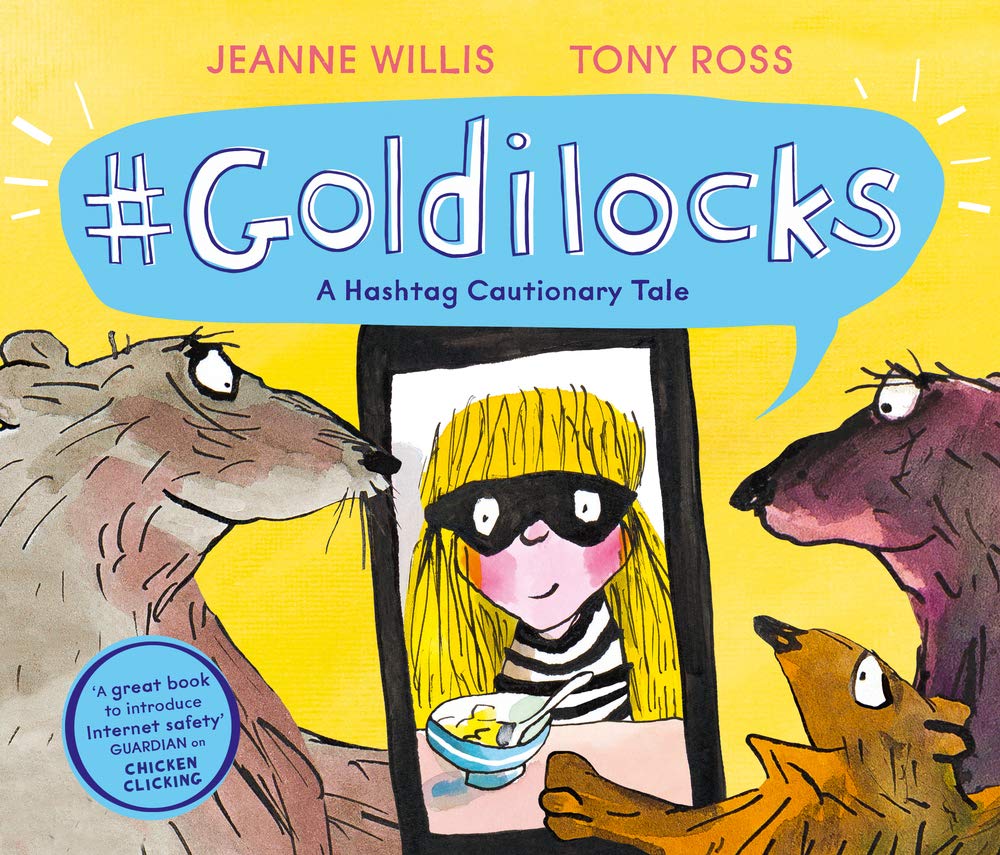
#Goldilocks by Jeanne Willis & Tony Ross Andersen Press
I am not sure when it was that I realised that the benign traditional tale of Goldilocks was actually about a child breaking and entering a house illegally. Perhaps the moral message had been lost within the humour of the young child’s misdemeanours and the glorious patterning of three which gave momentum to the story until she falls asleep in baby bear’s bed or the focus on Goldilocks’ search for something that was ‘just right’. Whatever it was, as a young reader, I missed it. Not so now, for Jeanne Willis and Tony Ross, whose gloriously clever retelling highlights the moral message of the tale with an important new angle for children of this technological age. Goldilocks is recast as a smart phone obsessive who wants to develop her popularity by increasing her following on social media. This pursuit of popularity through the number of likes for her posts draws her into ever more daring deeds and she shares her adventures in the Bear family’s house. I won’t tell you the ending but safe to say, she gets her comeuppance. Written in lyrical rhyming couplets with the trademark comedic illustrations of the writing duo, the tale bounces along with a deftness which conveys the seriousness of the philosophical message underneath. A delight to share with children of all ages and definitely one to be read aloud. It also allows parents and teachers an opening to discuss some of the perils of the new technological age should they choose.
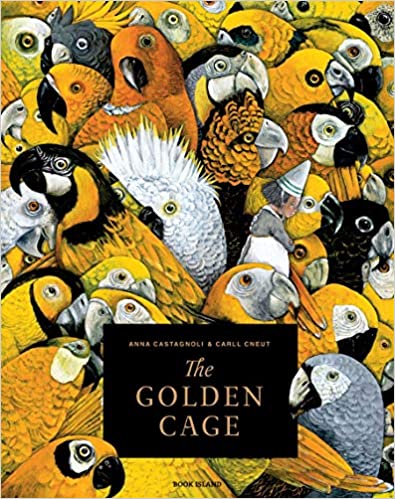
The Golden Cage by Anna Castagnoli and Carll Cneut Translated by Laura Watkinson Book Island
Jo Bowers is an Associate Dean at Cardiff Metropolitan University, lecturing in literacy to student teachers. She has a lifelong love of children’s literature and is a member of the English 4-11 Editorial Board. Jo is can be found on Twitter talking and sharing books with other fellow book lovers at @Jo_Bowers
This remarkable picture book really stands out with stunningly detailed illustrations by Carll Cneut, filling whole pages of the large hardback book to pore over alongside the text set out in green font and large pencilled handwriting. The illustrations also contrast starkly with the dark and chilling fairy tale of Valentina, the emperor’s daughter, who collects the most exotic birds from around the world to fill her birdcages in her garden and chops off the heads of anyone who dares to come back empty handed. When she dreams one night about a bird who can talk sweetly to her, she knows that this is the bird for her golden cage, that will make her collection complete. What makes this quite a unique tale is how the reader is allowed to decide the end for the Valentina waiting for her talking bird egg to hatch. Anna Castagnoli has beautifully written an unusual European fairy tale for older readers that will invite discussion and most definitely encourage a wealth of possible endings.