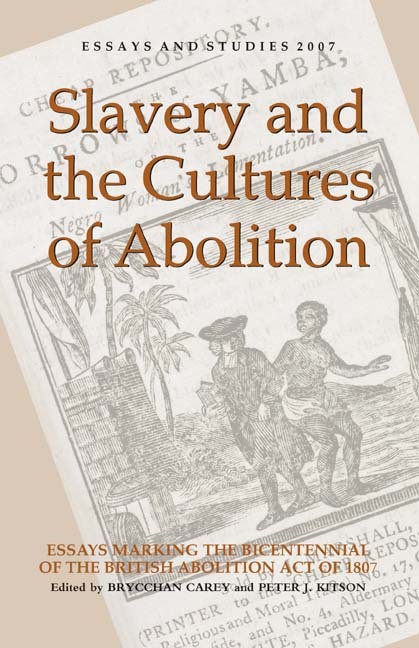
Slavery and the Culture of Abolition
Essays Marking the British Abolition Act of 1807, edited by Peter J. Kitson (University of Dundee) and Brycchan Carey (University of Kingston)
On 25 March 1807, the bill for the abolition of the Slave Trade within the British colonies was passed by an overwhelming majority in the House of Commons, becoming law from 1 May 1807. That same year the African Institution was formed to seek the enforcement of the Abolition Act and to further the market for trade with Africa in commodities other than that of human beings. In the same year the United States Slave Trade Act prohibited American citizens from participating in the African Slave Trade. Yet Rio de Janeiro recorded its largest annual import of African Slaves (18, 677) in 1810 and total slave imports to the Americas rose again in the 1820s.
After the Emancipation Act, British abolitionists were sorely discomfited to learn that, by 1840, there were more slaves in British India than had been emancipated in the British colonies of the Caribbean. The British Abolition Act (and the later Emancipation Act) has since been subject to intense scrutiny from revisionist historians who have debated its importance and significance.
The 2007 issue of Essays and Studies is devoted to essays addressing the literature, language and culture of Abolitionism and Slavery to mark the bicentennial of the Act. The volume is edited by Peter Kitson and Brycchan Carey and contains eight essays of 8,000 words which address a subject relevant to the culture of abolitionism and the legacy of 1807.
Leading scholars and critics in the field were invited to contribute to the volume. The volume is intended to address the moment of the Act itself but also its conflicting and ambiguous meanings and legacy over a wider historical and cultural field; issues such as the literature of slavery and abolition, remembering slavery, consumerism and commoditisation (sugar, cotton and other trades), the impact of abolition, slave narratives, women, gender and slavery, race and slavery, slavery outside the British context, religion and abolitionism, the politics of abolitionism; slave resistance and revolt; forms of slavery and the global context etc might be addressed.
Contents
- Introduction
- Emancipation Art, Fanon and the ‘Butchery of Freedom’ – Marcus Wood
- The Afterlives of Three-fingered Jack – Diana Paton
- Putting Down Rebellion. Witnessing the Body of the Condemned in Abolition-era Narratives – Sarah Salih
- The Horror of Hybridity: Enlightenment, Anti-slavery and Racial Disgust in Charlotte Smith’s Story of Henrietta (1800) – George Boulukos
- “To Rivet and to Record”: Conversion and Collective Memory in Equiano’s ‘Interesting Narrative’ – Lincoln Shlensky
- Henry Smeathman and the Natural Economy of Slavery – Deidre Coleman
- Slavery, Blackness and Islam: The Arabian Nights in the Eighteenth Century – Felicity Nussbaum
- Slavery and Sensibility: A Historical Dilemma – Gerald Maclean
- ‘Go West Old Woman’: The Radical Re-visioning of Slave History in Caryl Phillips’s Crossing the River – Mary Joannou
Publication date: 16 August 2007 £30.00 / US$ 60.00
Hardback, 18 b/w illustrations, 256 pages
10 digit ISBN: 1843841207 / 13 digit ISBN: 9781843841203
Purchase this volume